Cy_Borg Impressions: Cyberpunk Mork Borg!
I played Cy_Borg with my Monday GM group this week, plus solo ran myself through its starter adventure, so I thought I’d jot down some thoughts.

The Mechanics
Cy_Borg is a Mork Borg game, so the core mechanics are basically the same as all the other Borg games. 3d6 down the line for stats, Roll d20 + stat modifier vs a difficulty rating (usually 12) to see if you succeed at a task. The rules are simple and light enough to fit on a 2-page spread in the back of the book.
The default difficulty rating is 12, and players often won’t have a bonus, so actions are slightly skewed towards failure. This encourages players to find ways to tilt the odds in their favor and contributes to the edgy, grimdarkness Mork Borg games thrive on.
The game’s got some unique stuff going on that isn’t in other Borg games, too.
Hacking and Nano Powers
Hacking is often tricky in Cyberpunk games. You want people to be able to play hackerman, but you don’t want your hacker to be playing an entirely different game than the rest of the party. Here, hacks are handled like magic in other Borg games. You have a deck with slots you can use to activate applications. At first, I thought I wouldn’t like this, but most of the apps are about interacting with tech or people with cyberware. You won’t cast fireballs with your deck, but you’ll do stuff like open doors, take over turrets, and control security cameras. It feels like hacking because all the “spells” are hacking stuff instead of magic stuff.
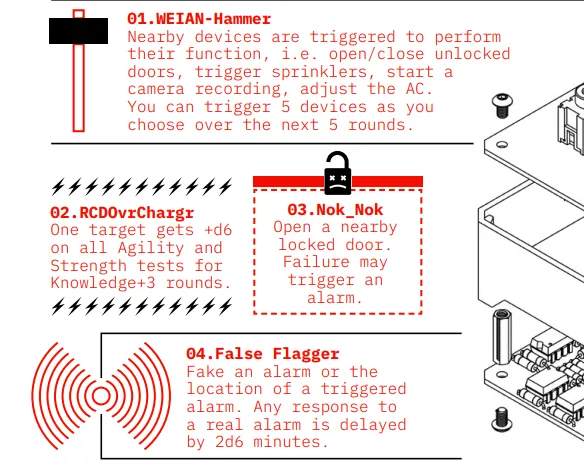
There’s a similar system in place for powers gained from alien bacteria infesting your body that do more of the traditional affects you might expect from a spell system.
Both hacking and infestation powers are dangerous. Botching one risks triggering alarms, burning your psyche, or causing radiation damage to people around you (this one is for botching an infestation power).
It feels appropriate. Hacking massive corporate entities feels risky but rewarding. The reward is tantalizing, but there’s always the risk of getting burned off the internet like Case in Neuromancer, which is clearly a big inspiration for the game.
Cyberware and Gear
It wouldn’t be a cyberpunk game if you couldn’t attach cybernetic parts to your body. They’re pretty straightforward here; they are just extra features that you have to pay to have installed. There’s a pretty wide variety, ranging from wolverine claws (lovingly referred to as either “Mollies” or “Logans”), to fashionable smart hair that lets you change your look at will.
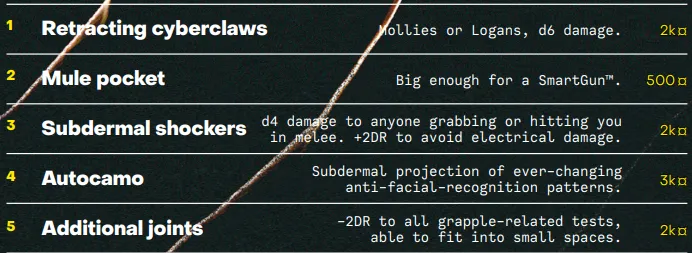
Installing Cyberware mostly has no drawback, except that if you go down (from hitting exactly 0 HP), you might get back up and go into Cy Rage. This is more likely if you’ve installed more chrome on your body. This is cool with me, I just want to chrome up, I don’t need there to be a downside.
The gear is also pretty meaningful here. In the session I ran for my group, the party rolled heat vision goggles, a pair of motorcycles, a crossbow grappling hook, and a grenade launcher.
This gear massively changed their approach to the dungeon. They used the motorcycles for fast entrances and exits, the grappling hook to swing from the ceiling, the heat goggles to find targets, and the grenade launcher to blow holes in the environment. So gear is not trivial. If I ran it again, the group would have very different options depending on what they roll.
Life and Death are Cheap
Characters have single-digit health and die as soon as they go below zero. Depending on what you roll, that can easily be a single attack. In my experience, there are two ways players respond to this. They either play super cautiously and defensively, or they go, “life is cheap, and character creation is fast, I’m driving my character like I stole ‘em.”
I have the most fun with the second approach. My players going guns blazing, blowing shit up, and managing to complete their mission with just one of them left standing was fun and dramatic. It also ties in well with the Cyberpunk themes. Life is devalued by the mega corporations, so too do the mechanics devalue life by making characters mechanically interchangeable and easy to put down.
There’s also a resource each character has called glitches that they can spend to reroll, reduce damage taken, or dodge a crit. You don’t get a lot of them, but they do embolden players while they’ve got 'em.
Simple to Run
Ultimately, the rules of most Borg games aren’t anything crazy, but they largely stay out of the way and give you an easy way to resolve actions. 90% of the time, a player asks the GM if they can do something, the GM just has to figure out what stat to tell them to roll. Making up a monster is super easy. All you have to do is decide their HP, armor, how much damage they do, and maybe some special attacks, if you want. You can do this on the fly, no problem.
The flipside of this simplicity is that it requires the GM to make lots of rulings. In our session, we noticed this with the heat goggles. As far as I can tell, there’s nothing clarifying how far they can see or if they can see through walls. You’re left to make this decision on your own. This doesn’t really bother me, but I suspect some people will wish there was a little more clarity on how some things work.
One thing I like about these games is that players do most of the rolling. When enemies attack them, they make a check to dodge, when they attack, they make a roll to hit. The GM only ever rolls for enemy damage and for enemy armor when enemies are hit with attacks.
My Gripes
Armor is actually one of my two gripes with the mechanics. Armor acts as damage reduction. Every time you get hit, you roll your armor die and reduce the damage of the attack by the amount rolled. So, if your armor is d4, and you get hit by an attack that deals 3 damage, you roll your armor die. On a 1, you would take 2 damage, on a 3 or more, you would take 0 damage.
I don’t like this. First, it feels like a superfluous roll. I get that it’s meant to add a little more variance to attacks, but I think the to-hit and damage rolls have that covered. It's a minor thing, and honestly, less annoying in practice than I thought it would be on paper, but it feels silly to me. Also, I don’t like a hit getting reduced to 0 damage. There is an optional roll for hits always dealing at least 1 damage, and I use that.
My second gripe is that when an ability gives a character a bonus on certain actions, it’s expressed as a reduction to the DR of the check, rather than a bonus to the roll. I would prefer it as a bonus to the roll, so players can just add it to their rolls themselves, rather than having to remind me to lower the check's DR. My players also found this way of writing bonuses to be unintuitive.
These are both minor complaints. They don’t matter too much, but they’re in every Borg game, so they annoy me a little bit each time I see them.
Presentation and Flavor
Layouts
Borg games are known for crazy, beautiful layouts, and Cy_Borg is no exception. There is sick art on every page, and I like how they didn’t shy away from including elements of the grotesque. In the starter adventure, there’s a guy wired up to a computer, and the art is an awesome mixture of cool, and gross. Including gruesome visuals helps the reader stay in the right frame of mind. This is Cyberpunk. Some of the tech is cool, but it’s a harsh, difficult world.
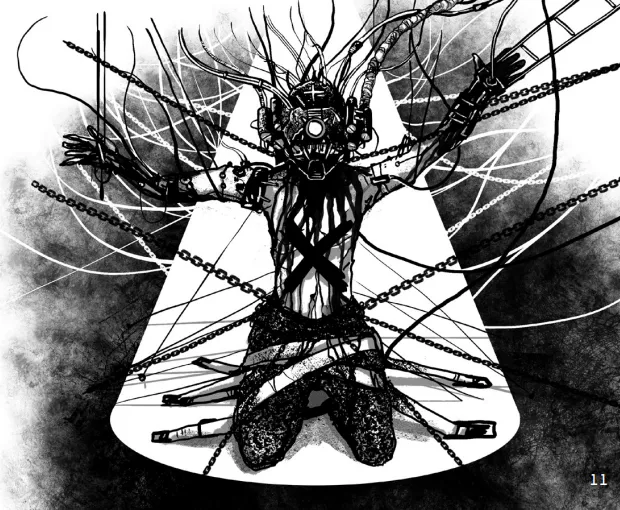
Borg games are often criticized for being difficult to read, but I think there’s an art to it. Some Borg games can have really difficult-to-read pages, while others manage to be highly readable without sacrificing the cool visuals. Cy_Borg does a good job here. Even the busiest pages are pretty easy to read, and I like how they use fonts and highlights to give pages the feeling of reading an old website or forum. The only area where readability suffers for me is that some page headers use fonts I struggle with.
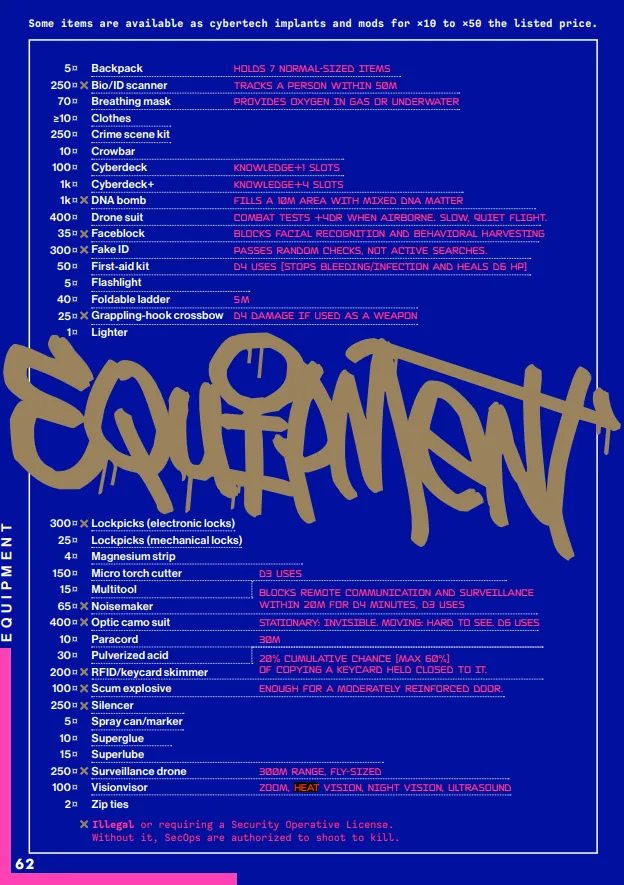
The book also has a quick reference in the back containing every game rule, and an index you can use to find any tables you need to, so even if you struggle with the layouts, it's easy to reference rules at the table.
Flavor
Cy_Borg takes place in the city of Cy, which is pretty standard Cyberpunk fare for the most part. Rich folks live in the hills, separated from the highly polluting corporate district and the slums where the regulars reside.
I do appreciate that Cy_Borg makes a point to paint corporations as unambiguously villainous. You can do whatever you want in cy_Borg, but Corps are the enemy, or at best, a temporary ally that will stab you in the back later. That’s how I like my Cyberpunk.
The setting feels very Neuromancer-inspired (as does the art), plus a healthy dose of cybernetics. The big addition Cy_Borg makes is the nano infestations. Basically, there are alien bacteria that can get into your body and give you weird powers, horrific physical ailments, or both!
I like the weirdness the aliens add, and it helps the setting feel fresh rather than a retread of popular Cyberpunk ideas.
Tables Tables Tables
The book is loaded with tables, most of which are practical and useful. You’ve got NPC generation tables, aesthetic tables, job generation tables, and random pocket find tables. Most of the stuff you’re likely to need has a table.
I also appreciate that they use the tables to expand on the setting. The aesthetic table is full of stuff like “Acid Panda” or “NuGoth” that help ensure you keep the punk vibes going when you make NPCs. Most of the time, even if you don’t know the terms being used, you can figure out what they mean, but there are occasional table entries that I barely know what to do with. What is hexcore style? Like you wear 6 of everything?
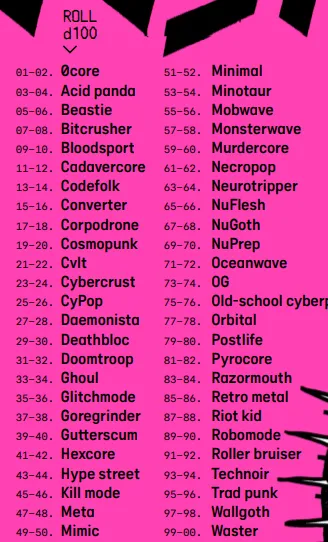
But barring a few results I can’t grok, the tables are evocative and functional.
Overall
Pretty cool game. The highlights are the art and layout, but I don’t want to understate how the inclusion of powerful gear and cybertech makes Cy_Borg characters feel more powerful than in other Borg games I’ve played, without losing the vulnerability Borg characters are known for.
Also hits a Cyberpunk vibe I like. High tech low life is well supported by a squishy bag of meat wrapped in chrome and techwear. You’ve got to be comfortable making rulings on the fly, and your players need to be comfortable with you doing that and not be afraid to die. But if you’ve got that down, then I’d try Cy_Borg!