Ruminating on Ronin's Random Tables
I ran the first half of Ronin's intro adventure last week and plan to finish it tonight. The game is sweet. You can check out the barebones rules for free if you're in the mood for some dark samurai roleplaying.
Intro adventures are great because they give me a better sense of how the developer intended the game to run. Ronin's publisher also put out a zine-sized adventure I'll run in the future.

I have a lot of thoughts on how the two Ronin adventures I read are designed, and I'll be writing a review of them later, but one of the things that interested me most was how they make use of random tables and encounters. This led me to consider how I use random tables in my games, and why.
The Crimson Jungle's Superior Weather Table
Randomness in Ronin's intro adventure, Blood Rains Over the Crimson Jungle is present from the first page, where a short d6 table for the weather lives.
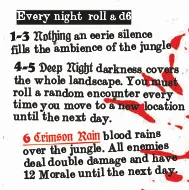
This table is excellent and better than most weather tables I see for two main reasons.
First, results matter. A lot of weather tables tell you whether it's rainy, sunny, or windy, but the result often has little effect on gameplay. These tables add an extra procedure to each day of travel, but the players forget about it a few minutes later. Not so here. A day in the Crimson jungle during deep night demands greater caution from the players. Crimson right is outright scary (maybe a touch too scary, but you can always tone it down). Once you roll a 6 the first time, players will start dreading the weather roll. That means they care about it.
Weather events being meaningful makes clear weather fun. Once your players see crimson rain for the first time, rolling no weather will make them feel relieved. It might even change their adventuring behavior. I can imagine a group deciding to push further on a given day because there's no weather and they want to make as much progress as possible before it rains again.
The second thing I like about this table is that it's efficient. Limiting it to three outcomes keeps the table short and easy to roll on. Each result is striking. It's better to have a table with 3 outcomes that players care about than one with 10 outcomes, only 4 of which are interesting.
The takeaway for me here, particularly in settings with wilder weather, is to add some spice to my weather tables! Blood rain, fog that physically weighs you down, clouds that block out the sun completely, whatever.
If my players don't care about the weather when I roll on the weather table, it needs to be adjusted or dropped.
Tables for Filling Gaps and Setting Tone
The next page of the adventure has two more interesting tables. One for exotic flora found in the jungle, another for echoing sounds the player characters may hear.
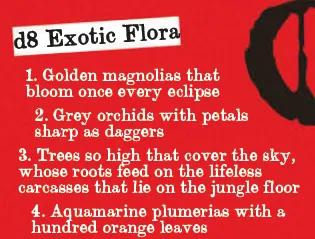
These tables served two different purposes. The exotic flora gave me a list of things I could add to any area where my players lingered longer than the adventure expected them to. Adventure writers don't know what players are going to latch onto. Tables like this can help fill in the gaps. Any time the players meandered in the forest beyond the scope of the written encounters, I could make a quick roll on this table and give them something interesting to find.
While there are no explicit mechanics tied to these plants, players will still find interesting ways to use them. When I gave my players the orchids with dagger-sharp petals, they used them as improvised shuriken. Neat!
The echoing sounds table, on the other hand, was wonderful for tone-setting.
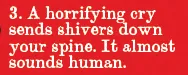
I rolled on this table each night, and combined with the weather rolls, it helps set the tone of horror even before the adventuring day starts. If you don't want to roll on it every night, you roll on it whenever you want to remind the players that they're in a horror game.
These tables also have a secondary benefit in Ronin. During meditation (a method for restoring resources), players are prompted to write a Haiku. Many haiku are observational, including elements of nature and the world around the poet. Including tables that describe nature doesn't just help the player get into the mood of the adventure; it helps fuel their next haiku!
Encounter die rolls
A deadly foe approaches
Lol, lmao, get fucked
I have two takeaways here. First, tables that provide information about the world around the players can help fill gaps in an adventure. This might be less needed in an adventure you write for yourself, but even then, it can act as a nice writing prompt. Making a small table of flora in an area forces you to think about the fauna in an area! I will be making more tables like this.
My only complaint here is that there is no guidance on when to use these tables. This is not an issue for an experienced GM, you use the tables whenever they are helpful. But since this is an intro adventure, some guidance would be helpful for newer GMs who may be overwhelmed by the number of tables, with no obvious explanation of their use.
Random Encounter Tables
In addition to rolling for random encounters as the player characters move about the jungle, Blood Rains Over the Crimson Jungle has keyed locations that call for a roll on the random encounter table. I was expecting not to like this. If you are going to have a written-out location, why not tell me the monster to put there instead of having me roll on a table?
In play, I could see the vision. Rolling on the table randomly creates surprise for the GM to enjoy. Not knowing exactly what would be in each location until the players did was fun for me. This could also add some value if I were to replay the adventure with another group. The adventure would be different each time, though not by much.
Still, while I see some benefits to how random encounters are implemented, this is the first place where Blood Rains Over the Crimson Jungle's tables are a bit of a miss. There isn't anything wrong with the encounter table itself, which includes 6 possible monsters for the players to encounter, ranging from living statues to a venomous snake, to a group of lookouts from the demon clan. So a wide variety (remember that, it's important).

My issue with the table is more about where it is used. The book calls for a random encounter roll in a few cases:
- To fill a monster lair in the jungle
- To fight the party if they approach the decomposing bodies by a pile of rocks
- For a wild predator that catches your scent if you fail to cross a river quickly enough
- Every time the party goes to a new location if you roll a 4-5 on your weather roll
Do you see the problem here? One table should not govern all 4 of these situations. It makes perfect sense for a lion to catch your scent near a river and hunt you down, or have a lair in the middle of the jungle, but a statue? Not as much.
There's nothing so out of place that it can't work with a bit of tweaking. You can ignore results that don't make sense, or slightly change how the random creature finds the party, but at that point, the table is not helping me too much, and I'd rather the adventure give me a specific monster to use.
The takeaway for me here is to write table options that make sense everywhere the table is used. Tables should be very smooth to use during play. If I have to spend time thinking about how to implement a creature into the area, it shouldn't be in that area's random encounter table.
To be fair to the adventure, one challenge it faces that I usually don't is that it is a pointcrawl; the party will likely be traveling for a little less than a week across a few different environments. It's hard to make a perfect table for use in a jungle, a cave, and a temple, but bespoke tables for each area, or fewer keyed areas using encounter tables, could help.
When is a Random Encounter Table Additive?
Reading through the second Ronin adventure, Frozen Tears of the Lady of the Snow, it follows a lot of the same sensibilities as Blood Rains Over the Crimson Jungle. Camila Mera wrote both and also wrote The Pale Curse of Yakedo Castle for Mork Borg, which I haven't read yet, but looks gorgeous.

This adventure features similar tables from Blood Rains Over the Crimson Jungle, including a meaningful weather table and a sweet table for ancient weapons the party might find.
However, there's one use of a random encounter table in here that I really don't like.
The adventure begins in Hinoki Village, a small locale suffering from a months-long blizzard. When you arrive, a helpful NPC named Himiko asks you to climb a mountain and visit a temple to uncover the cause of the blizzard. She'll even come along and help, as long as you help her deal with a "malign presence" in the village's decrepit hall.
Solid opening. I was excited to see what the malign presence was and how it tied into the adventure. It was a perfect opportunity to hint at the supernatural power that is cursing this village.
It's a random encounter. Some of the options on the table are sufficiently spooky; there are specters, ghouls, and Yokai. But there's also a bear. The malign presence is a bear?
Obviously, you could build a better table to avoid results like this, or ignore the options that don't make sense, but why make this a roll at all? It's the first thing the players are likely to do, and if you tell them they have to go up to a temple to investigate a magical blizzard, and there's a malign presence in the town hall. They're going to think those things have something to do with each other. You can add that context yourself, but I'd rather have an exciting monster with a reason to be here in the text of the adventure. A random encounter here misses the opportunity for the monster to tell a story.
This made me consider what situations are best for a random encounter roll. They are a great choice whenever you have a repeated task that may result in combat, or when the specific location of combat is not obvious. So that's things like a random encounter table for long-distance traveling, or having a chance for an encounter each time a party checks a building in an abandoned town. In these cases, tables allow the GM to have content for a wide variety of potential player actions, without having to make a bunch of bespoke content for stuff players might not even do.
For keyed locations, random encounters add an element of surprise for the GM. I still prefer most keyed locations to tell me the monster that's there instead of having a table of potential monsters that could be at a specific keyed location. Still, I found the keyed random encounters in Blood Rains Over the Crimson Jungleto be more fun than I anticipated.
Takeaways
Ok, Ronin uses a lot of tables, and in ways I haven't After running it and seeing what I like, here were my key takeaways:
- Add sauce to your weather tables. If your players don't care about the weather roll, you shouldn't bother doing it, so if you want weather tables, make your players care by making weather matter.
- If you are using a random encounter table for a variety of different locations, be sure that each result works well in every location where the table is used.
- Random tables with flavorful information like fauna, noises, etc, can help GMs fill in gaps when the players do stuff outside of the written adventure. They can also reinforce tone and genre.
- Even in keyed locations, random encounters can add a little bit of fun and surprise for GMs, especially if they are going to run the adventure more than once.
- Random tables can get in the way if they are used in climactic moments. Don't let a random roll steal an opportunity where a specific monster choice could add intrigue to your game.
I'm definitely going to be rethinking my weather tables.
I'd like to end with one more plea for you to check this game out for yourself. The book is lovely, and my table has had a blast with it. If you are on the fence, the free version is very generous, it even includes the game's bestiary!
Enjoying the blog? Subscribe below for updates each week on new posts, and to be the first to know about any major releases.