Thinking About Death Mechanics
I’ve been working on a little Year Zero engine samurai hack (working title: Folded Steel), and it's got me thinking about how death is handled in TTRPGs. What makes you die, or even what happens when you hit 0 hp, is something I haven’t thought about a ton prior to the last couple of weeks. Let's walk through a few variations on death from systems I’ve played lately and how I think they work, then I’ll explain what I came up with for Folded Steel.
Simple death at 0 or -1 HP (Ronin, Mork Borg)
This is one of the easiest death systems to understand and is how people who have never played a TTRPG expect things to work. This is one of the biggest strengths of this method of handling character death: it’s straightforward, easy to remember, and intuitive.
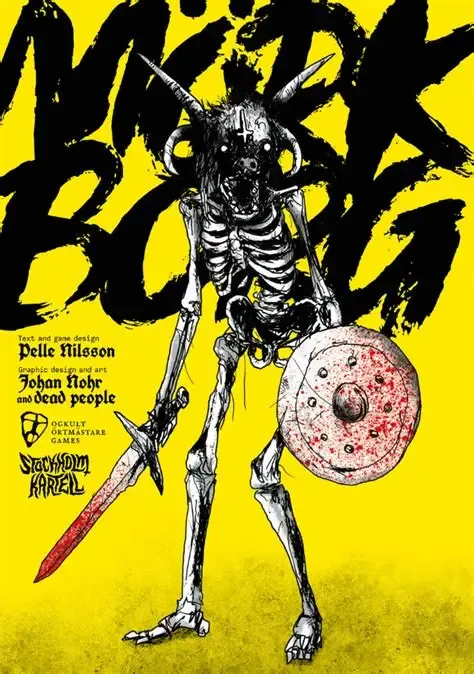
This system also creates a lot of tension when a character is at low health (which is the case all the time in some games that use this method). When a single attack could result in instant death, every closed door or locked chest can carry life or death consequences. As a result, players will usually play cautiously in these games. Every decision carries a lot of weight, which adds drama, but it can also be stressful for players or lead to analysis paralysis.
Death at 0 HP can also easily result in a lot of deaths that are not very dramatic. Not inherently a problem, in something like Dungeon Crawl Classics level 0 funnels, where you play a bunch of level 0 characters with the expectation that many will die, easy death is a feature. However, if you want every death to be climactic, as some people do, death at 0 HP does not facilitate that. Some deaths will be climactic, some won’t. Sometimes the characters get killed by the random goblin, or the pit trap, or a boat smashing their lemon head in our last Dungeon Crawl Classics game.
Healing gets an interesting dynamic in this sort of game as well. In games where you get downed, healing can be done after an enemy uses their big attack. In death at 0 HP games, though, you need to be a little more proactive. You need to decide when someone is at risk of going down, rather than using your healing to “undo” an attack that takes someone down. I prefer this; it makes decisions around healing more dynamic.
Mork Borg and its derivatives, in particular, give you a way to mitigate some sudden deaths with omens. Omens are an optional rule that gives you a resource you can use to reduce damage, avoid crits, and reroll dice. Sudden deaths really only become common once you run out of omens, so they give the players a little more agency, in exchange for losing some of the tension you get from a low hp system where you die from going into the negatives.
Games that use this method for handling death usually have quick character creation, so if your character bites the dust unexpectedly, you can roll a new one and get right back into the action.
Downed State With Death Saves (5e D&D)
I don’t actually know too many games besides 5e D&D, and its derivatives that use death saves, but 5e is so popular that it feels worth discussing.
In 5e, when you hit 0 hp, you go down, you can’t do anything while you are down, and on your turn, you make a death save to see if you stay alive. A death save is a straight d20 roll; 3 successes (10+) before 3 failures (9-), and you live; otherwise, you die. An ally can heal you to get you back on your feet, regardless of how many successes or failures you’ve accrued.
On its face, this sounds kind of fun to me. Every death save has an opportunity to ratchet up the drama of a fight. If someone fails the first death save, the party really feels the pressure to go pick them up before they can fail another. It works pretty well at level 1 when spell slots are limited, and you aren’t swimming in healing potions.
Before long, though, the system struggles more. Once the cleric has 8 billion spell slots and healing word, picking up a downed party member becomes trivial; you can do it from a distance and without spending an action. Plus, the more you play, the more you realize death saves actually give you a lot of time to respond, usually in the range of 4-6 turns. I have played a lot of 5e with many different GMs, and I think I’ve seen someone die to death saves 1 time.
Instead, most deaths come from GMs finishing off a downed target by having an enemy execute them before the party has a chance to heal them. This is a bad way for most deaths to happen, though, because GMs hate doing this. New GMs in particular feel terrible about attacking downed characters, and even experienced GMs often try to avoid it. It feels bad to literally kick a character when they’re down.
My big takeaway from this was to avoid adding options the GM won’t want to take. If using a mechanic makes the GM feel bad, they won’t use it, even if it might make the game “better”.
Down With Going Down
While 5e is the only system I know of that uses death saves, lots of systems have “going down” as a mechanic, and I don’t love it in systems with long combat encounters.
The thing about going down is that once you are down, you usually have nothing to do until the combat ends (or until someone gets around to healing you). In 5e, this can take 30 minutes to an hour, depending on how quickly your party fights. I don’t want to take someone out of the game for that long, regardless of whether they die or survive in the end.
I am ok with going down in systems that are a little quicker, which is why I use it in Revolver. In Revolver, Combat is very quick, rarely lasting more than a few turns, so if you go down, you don’t miss out on much. But even then, thinking about death mechanics more has made me wonder if it’s better to just do away with the downed state in most cases.
Injury Tables With Death as a Possibility (Genesys, Revolver, Year Zero Engine, lots of other systems)
This is the death system used in Revolver. Whenever you go down, you take a critical injury. You roll 2d6 and add the number of injuries you already have; 12+ is death. Lots of games have similar systems. I got the idea initially from Genesys, which has a much larger table.
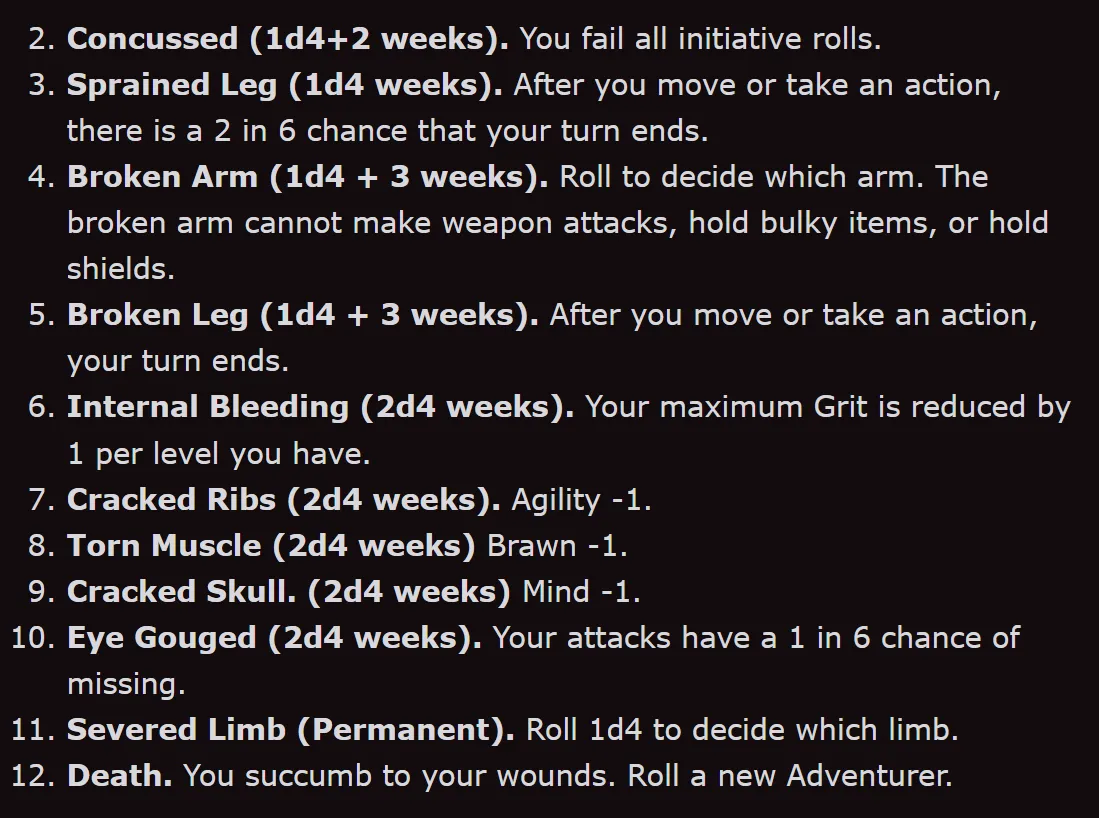
How you design the table is actually a pretty big deal. In Genesys, I believe it is impossible to die on your first injury, because the table goes past 100, instant death is at the top, and you roll 1d100 on the table. So you can only die once your character has already taken a bit of a beating.
I wanted death to be an immediate possibility in Revolver, so it’s 12+ on my 2d6 table. The first time you go down, you have a 1 in 36 chance of dying, with that chance increasing for each injury you sustain. You can get rid of injuries by spending time between adventures recovering, so how long to spend between adventures is a decision with some mechanical weight.
I like this system (otherwise I wouldn’t use it!) as it keeps tension high like death-at-0hp systems do, but it isn’t quite as punishing, so the players are more comfortable experimenting and taking risks than they might be otherwise.
It’s worth noting that if you don’t make the injury table pretty aggressive, I find characters don’t die that often. If characters get too beat up, players tend to take the time to rest up and heal their injuries. I’m ok with this, time passes while they recover, the world moves on, and opportunities are missed. The important thing is that injuries and a small chance of death are enough that players really don’t want to go down, meaning they try their best to avoid traps and approach encounters thoughtfully, which is all I want.
Folded Steel
For Folded Steel, I am going for the feel of an anime sword fight without getting too into superhero territory, so lots of action, fights going on for a few rounds, but once someone gets stabbed, they die.
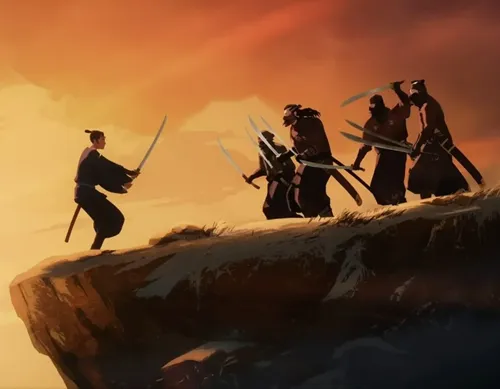
So I replaced HP with composure, which will stay pretty low. You start with 6. As long as you have any composure, you won’t die. While you have composure, you parry, avoid, and take grazing blows. It's sort of like having rings in Sonic the Hedgehog; just one is enough to stay alive.
When you hit 0, though, you have a choice. You can surrender or retreat at the cost of honor (hitting 0 honor will see you thrown out of your clan or executed), or you can continue fighting with 0 composure. At 0 composure, whenever you take damage, you must make an endurance check (similar to a con save) or die.
Composure cannot be restored during combat.
I’m hoping to playtest in the next few weeks, but the goals here are:
- No one is ever forced to go down. You are in the fight until you die or choose to stop.
- GMs are never put in a position where they have to decide whether or not to attack a downed target. 0 composure characters are an active threat, so there’s no reason for enemies to stop attacking them.
- Capture the feel of high-stakes combat, where a single blow connecting is likely to kill you.
Big takeaways
My biggest takeaway from looking at death systems was that I should think more about them in my own designs. But here are a couple of specific thoughts.
- A highly lethal system should have fast character creation.
- GMs feel bad about targeting helpless characters. It’s best not to design a system that works better if they do.
- High lethality makes actions high risk, which can either make players more thoughtful or really risk-averse.
- Being downed is boring. It's best if a player doesn’t have to spend a lot of time on the ground doing nothing.